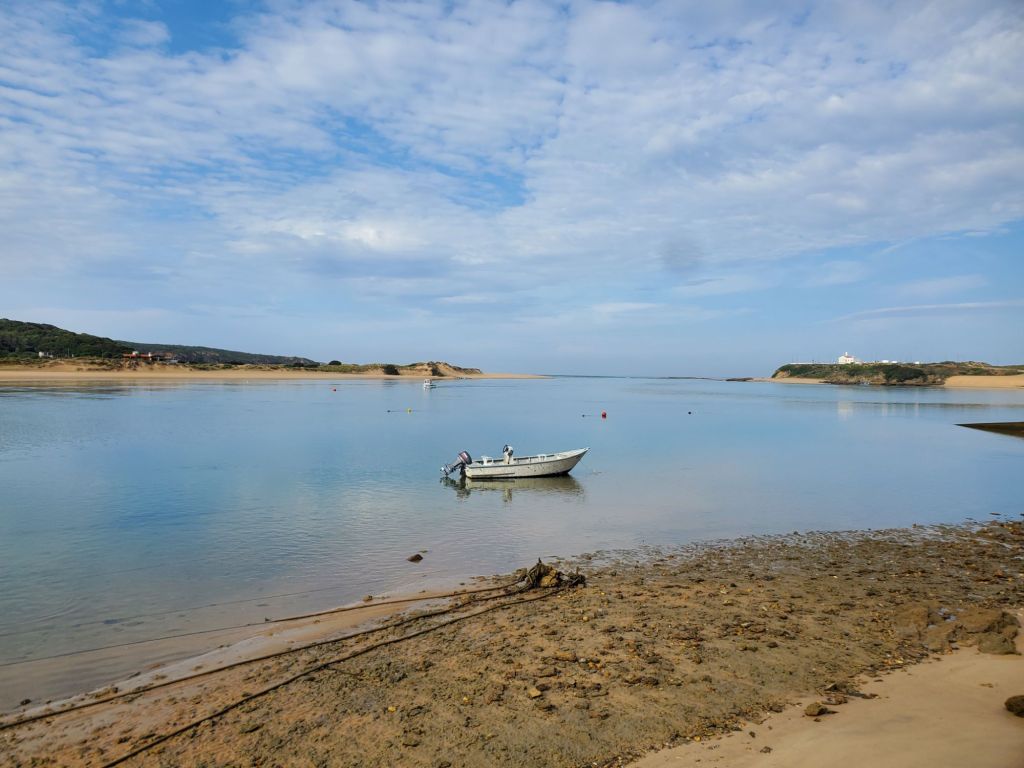
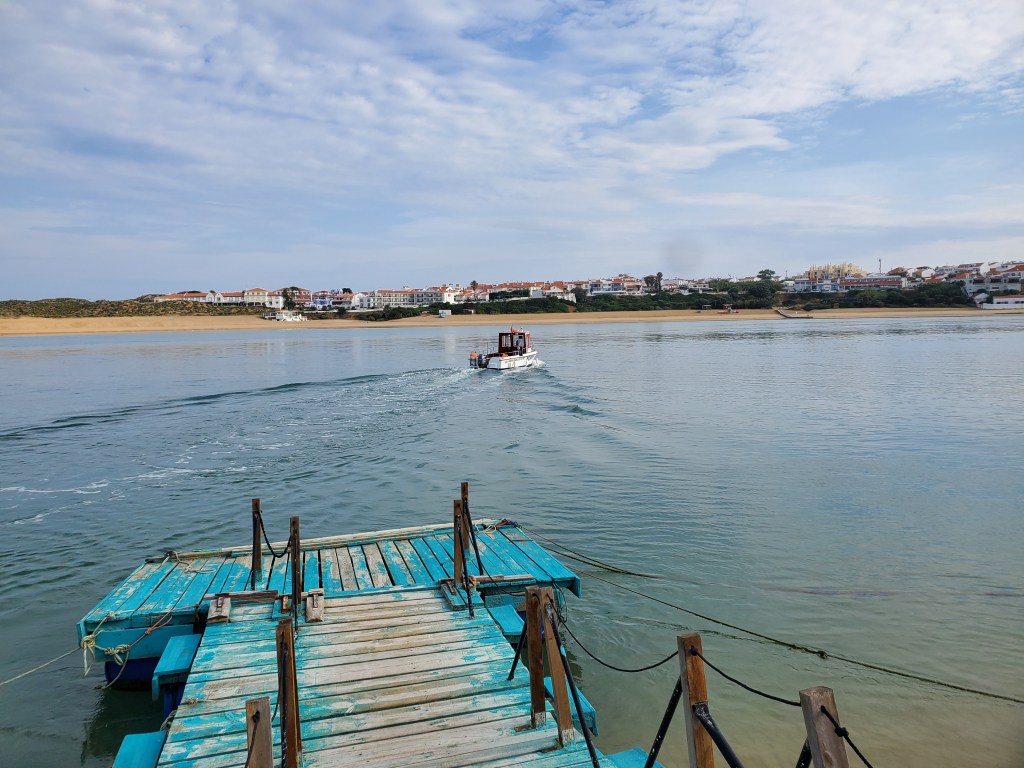
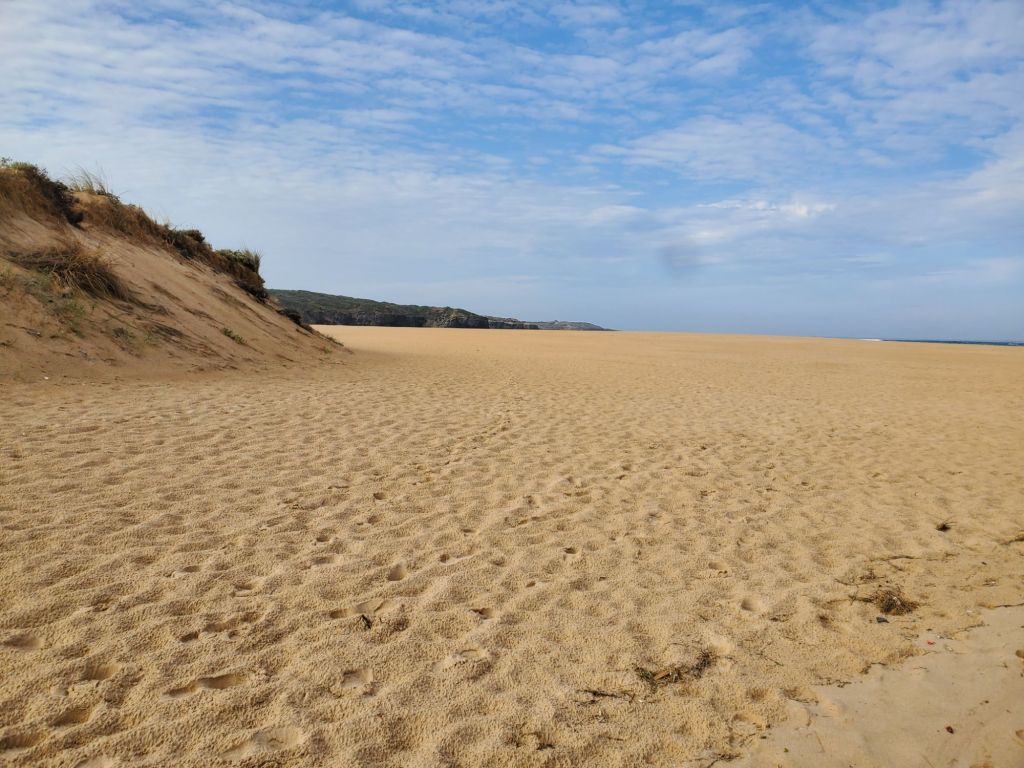
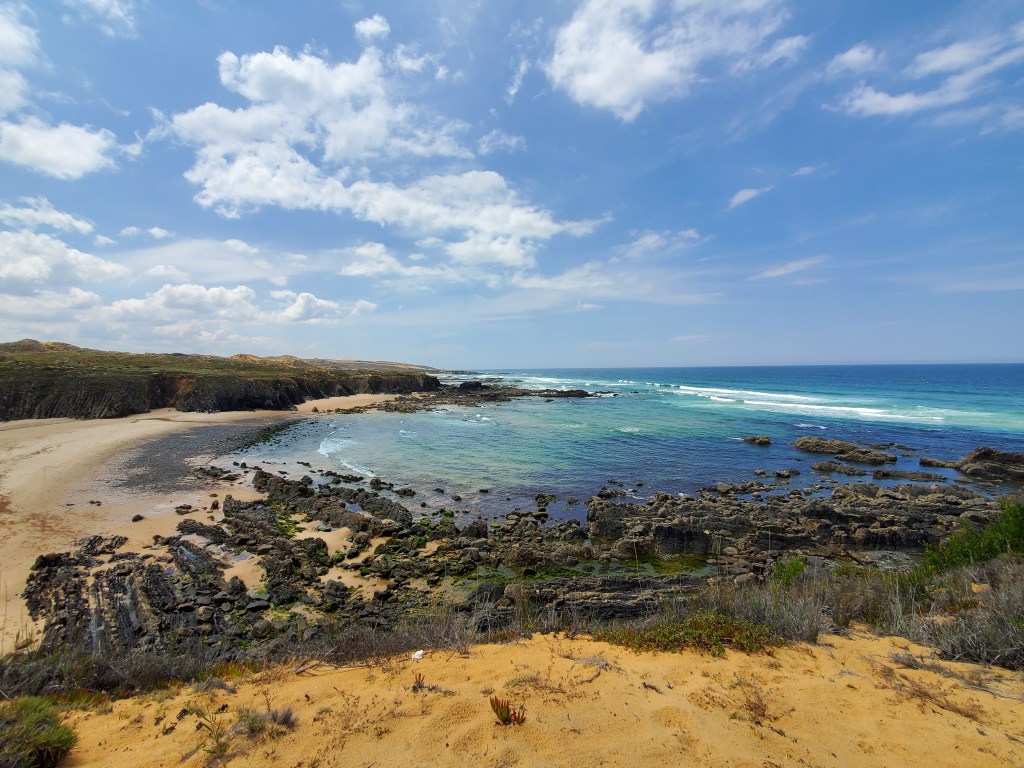
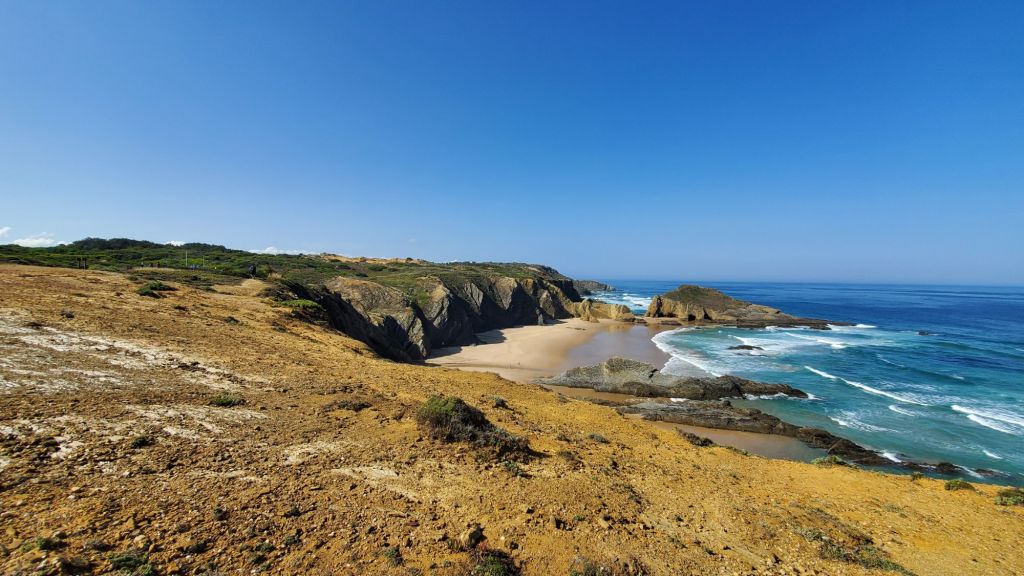
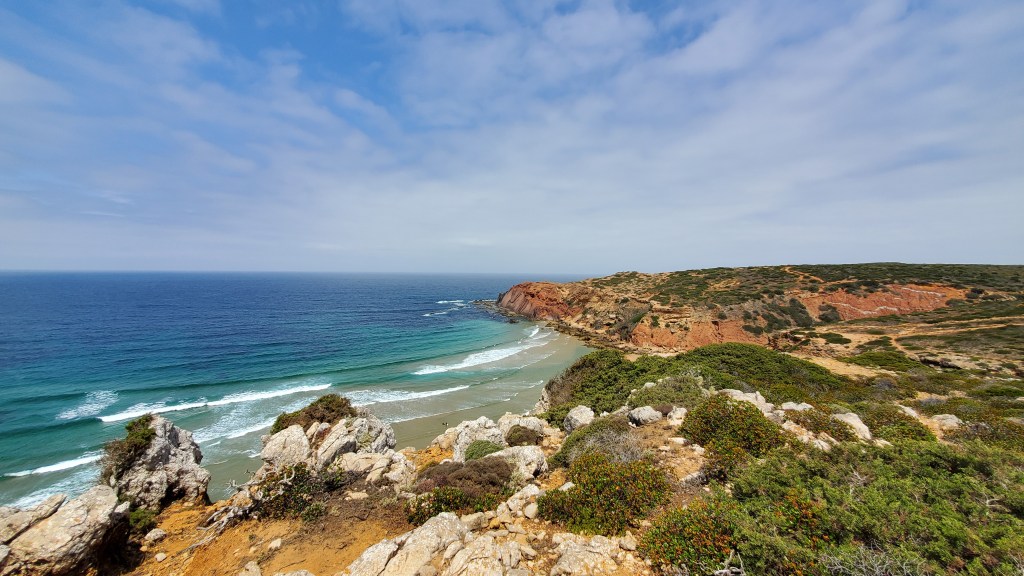
I met the old man by the sea on a deserted beach on the second day of my journey to the end of the world not far from a waypoint village of white-bleached houses and a thousand fountains. The beach, Praia das Furnas, a boat ride across the Mira River from the village, Vila Nova de Milfontes, begins where the river empties into the Atlantic, the bend in the river making for an almost genteel meeting of the waters for just around the corner, the surf foams and the winds rage. The beach stretches towards forever before disappearing into a distant haze of ocean mist; to my right, westward, the expanse of sand, burnt a golden brown, is over 100m from the breaking waters of the Atlantic. And it is deserted. Except for the old man.

Gods and sea monsters, he repeated with a slight edge to his voice, perhaps not liking my doubting look.
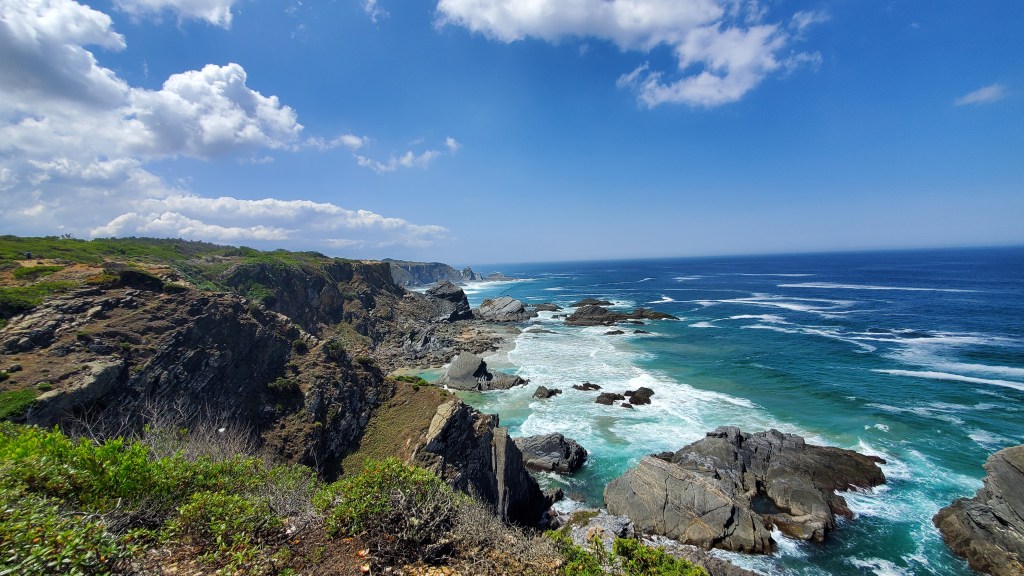
It must have been some war, I replied, this war between Gods and sea monsters. That it was a fanciful tale was obvious, but the old man nodded sagely, jerking his head towards the precipitous cliffs, massive boulders, and jagged rocks strewn across the water’s edge and scattered farther out from the shore, still visible in the shallower reaches as if proof of a hellish fight, if needed, couldn’t be any plainer. Indeed, the boulders serrated by the coursing Atlantic and the fierce winds do look like the keeled remnants of slain sea monsters. Probably, the old man was paying homage to the ancient Greeks, conjurers of considerable renown of tall tales, who regarded this, the southwest coast of Portugal, as the land of serpents.
Perhaps my look conveyed some doubt, but the old man apparently satisfied with the proof of his tall tale even if I wasn’t, picked up his fishing gear and, with an emphatic harrumph, ambled off – away from this non-believer to a quieter fishing spot, a place less-crowded. How much quieter and less crowded of a spot he would find I wasn’t sure for there was no other soul on the beach. High up in the cliffs, a distant and lone hiker was fading from view, but here on the sandy shores, a bay really, the beach lay empty and desolate and utterly breathtaking.
As I continued my journey – each day, with the slightest of variations in wide-eyed wonder moments, the same as the day before – I thought often of the old man and his fanciful tale, perhaps he wasn’t some unhinged flotsam. How else to make sense of this wild and remote and largely deserted corner of Portugal? That something cataclysmic had happened once upon a time when the world was new and things and places had no names was obvious, but a war between Gods and sea monsters? Whatever it was left behind something almost ethereal in its wake – there are no outside noises here to disturb one’s solitude, not even on overhead aircraft, just the wind careening into cliffs, the cry of seabirds aloft on thermals, and the booming crash of the Atlantic on craggy shores. It’s the sameness of it all that is the wonder. There are endless empty beaches, endless sheltered coves and more empty beaches, endless skies, endless moorlands of wildflowers, and the endless blue of the Atlantic. This is a land where adjectives flail, superlatives are enfeebled, and hyperbole just about captures its essence – there are no roads, no mobile service, and very few fellow travellers on the trails, just the sky, the sea, and the wind. Around every corner awaits another vista that stuns the senses. It is as if competing Gods had played one-upmanship before time began, each adding artistic flourishes of transcendent grandeur, a masterpiece around each corner. And the best part – I am mostly alone here, alone to feel the smallness of my existence, alone and lost in the wonder of it all. Who could have expected this on a journey to the end of the world?
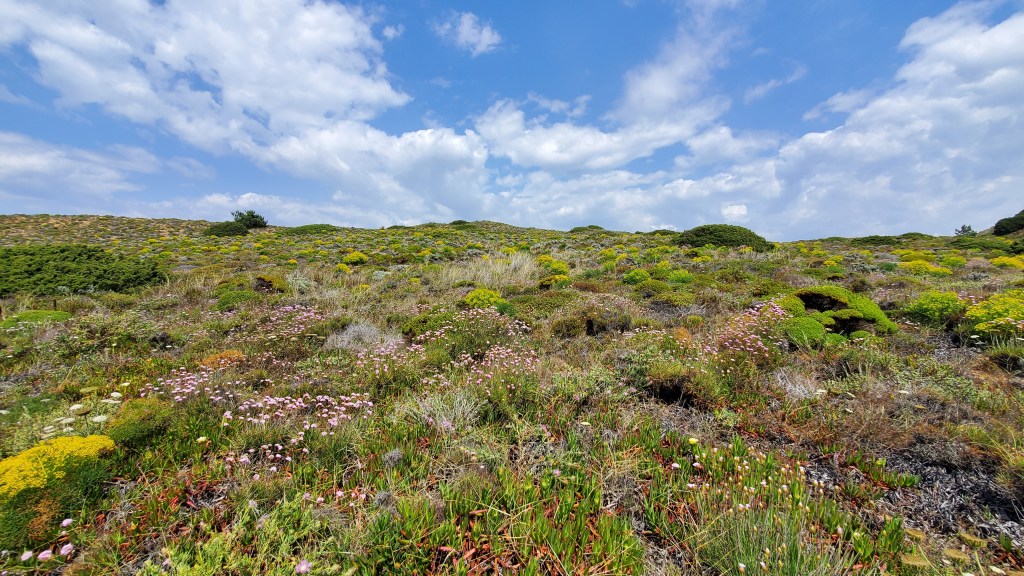

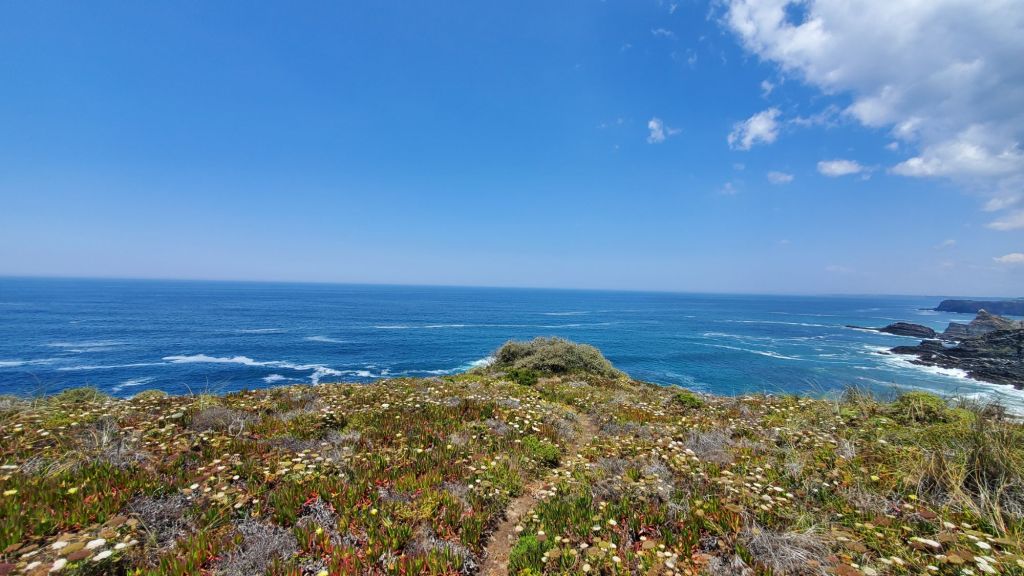
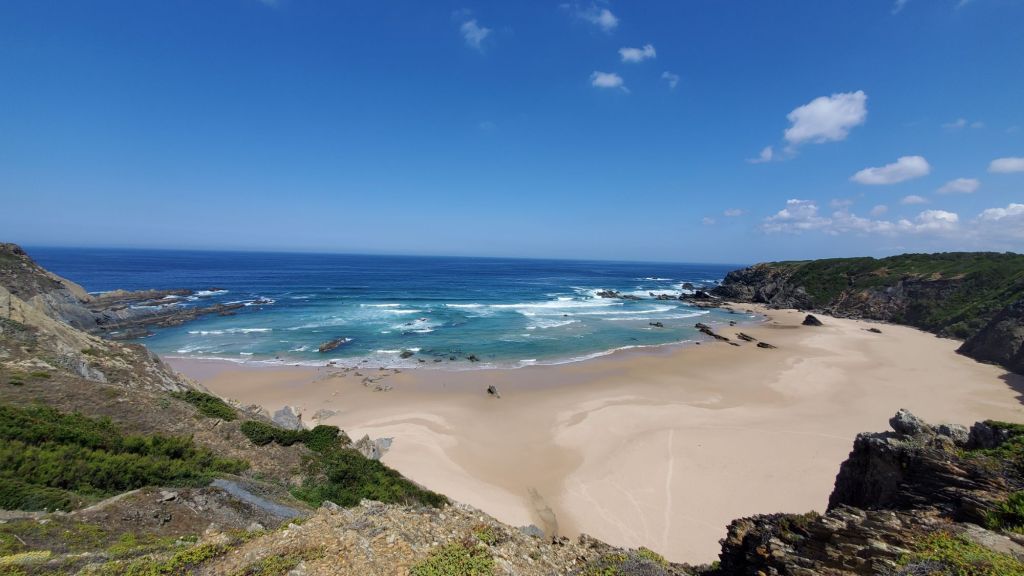



That the journey would be occasionally perilous, I expected. That it would be marked by gastronomic feasts at various waypoints, that too was not wholly unexpected – this is still Portugal after all. But that it would be so spectacular, so exhilarating, and so life-affirming wasn’t at all expected.
My journey to the end of the world began with expectations in check under a blazing early morning sun in Praia do Malhao, a surfer’s haven, about a three-hour drive southwest of the capital, Lisboa. The sheltered portion of the beach easily stretches over 300m and is crowded with about ten surfers in search of not just that big wave, but many big waves, and finding them. They are, as is the wont of surfers the world over, a peculiar bunch speaking a language indecipherable to my ears – and they are enraptured by the waves. These are the only humans, besides the eight other intrepid hikers in my group, I shall see for the rest of the day as I begin my trek on the Rota Vicentina, a series of walking trails of over 700km beginning in southwest Alentejo and continuing south to the Algarve. The entire path is within the borders of the Parque Natural do Sudoeste Alentejano e Costa Vicentina (Southwest Alentejo and Vicentine Coast Natural Park), an almost 900 sq. km of protected lands.
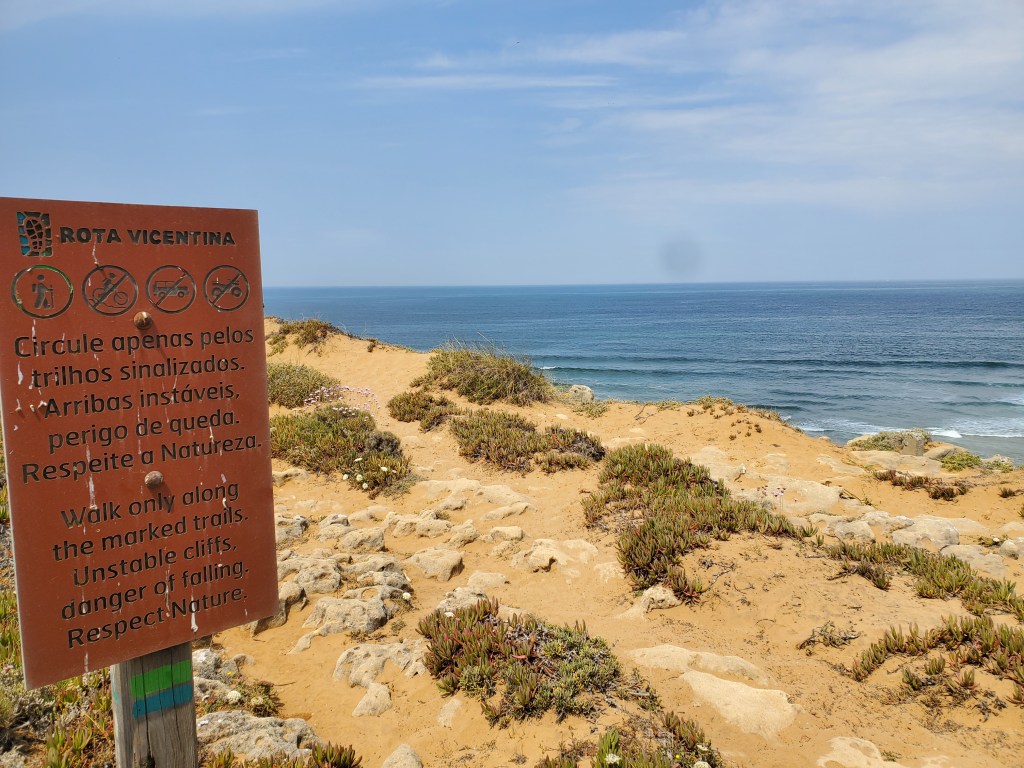
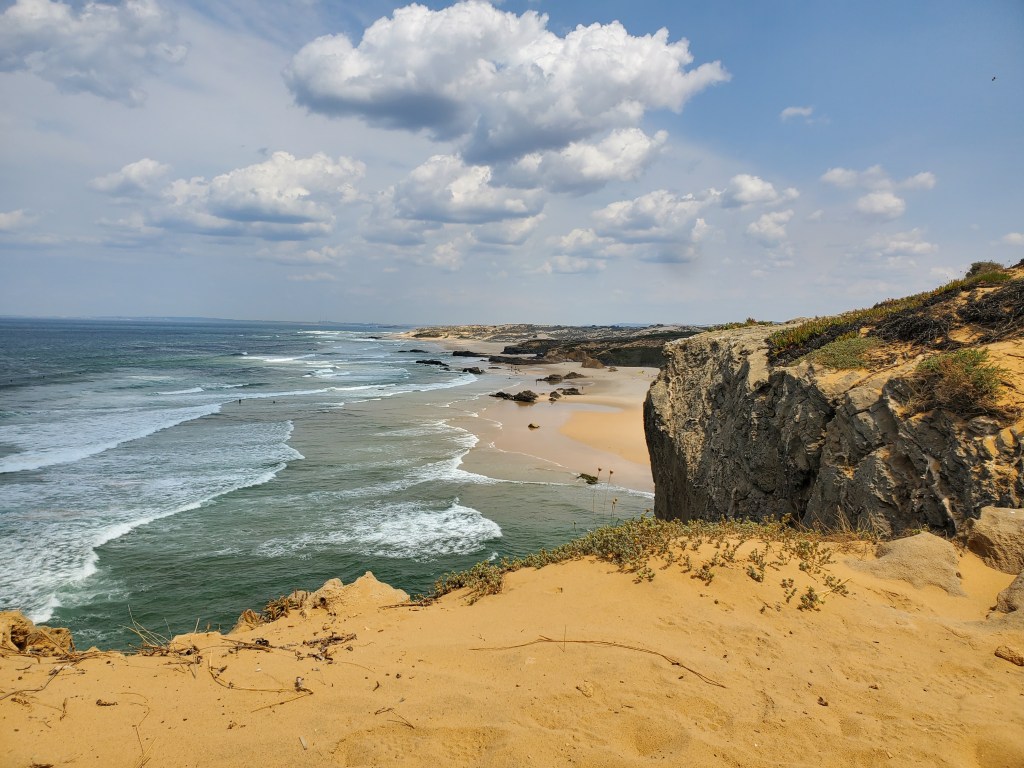
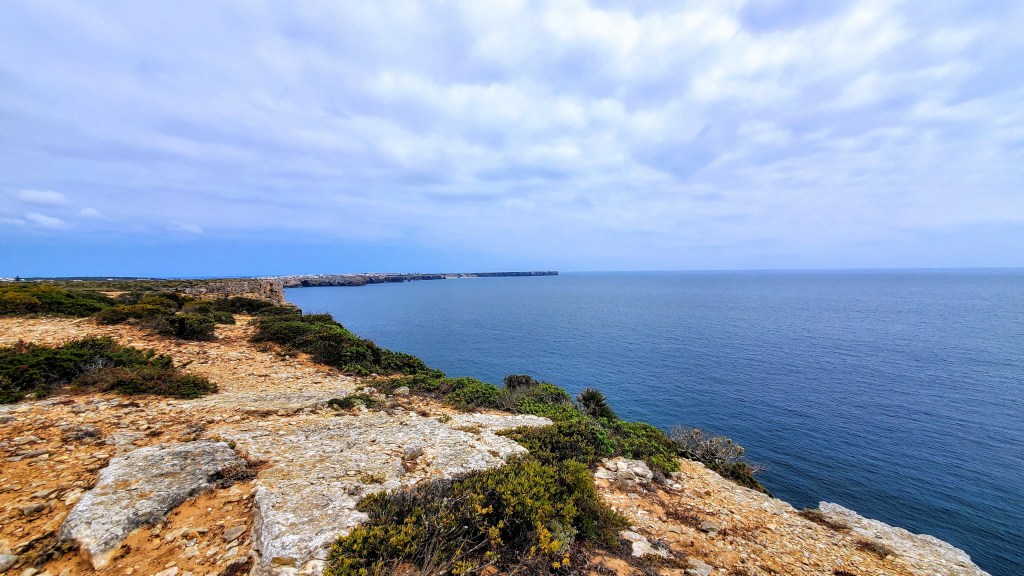
Not having a lifetime or the fortitude to walk 700km, I opted for a manageable 100km section of the 226km Fisherman’s Trail, used by local denizens to access fishing spots or their own secret beaches. I give the others in my group a good start and within minutes I am alone as they disappear around a corner. The trail is well-marked and fairly easy to follow; its narrow footpath snakes along cliffs, cuts down to the shore and across beaches of golden sand, up to the cliffs again and through plateaus of wildflowers, down to the shore, up again to cross a moonscape of dunes, detouring through farmlands, and cutting into woodlands. All of it along an endless coastline of magnificent desolation and unparalleled splendour.
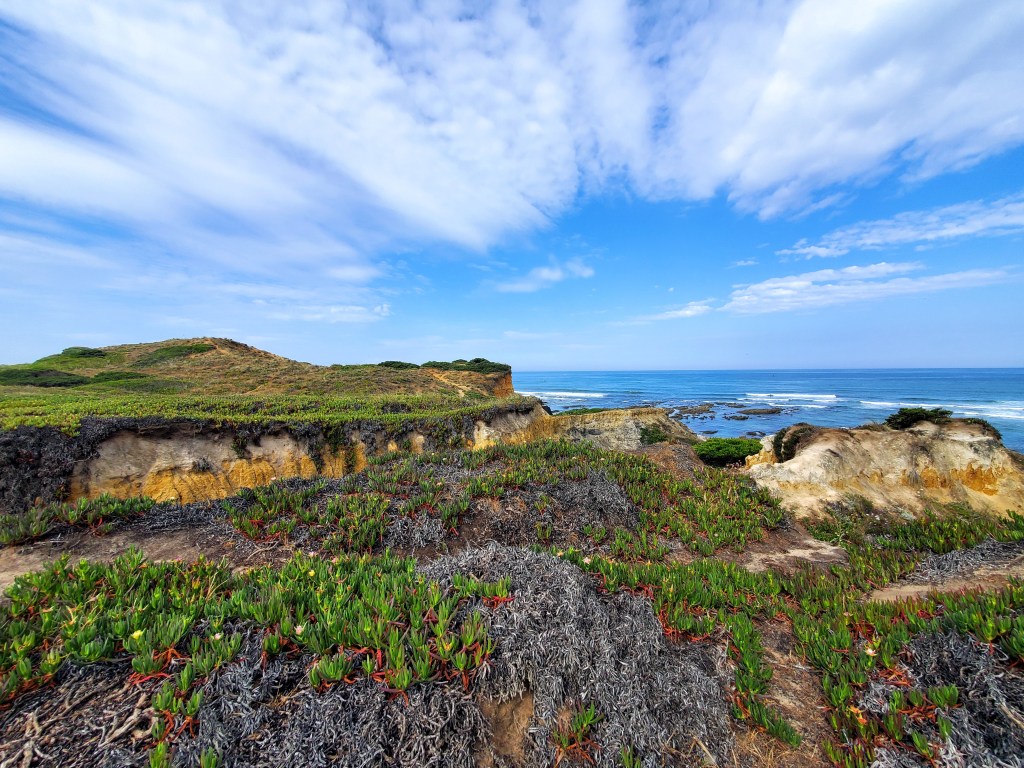
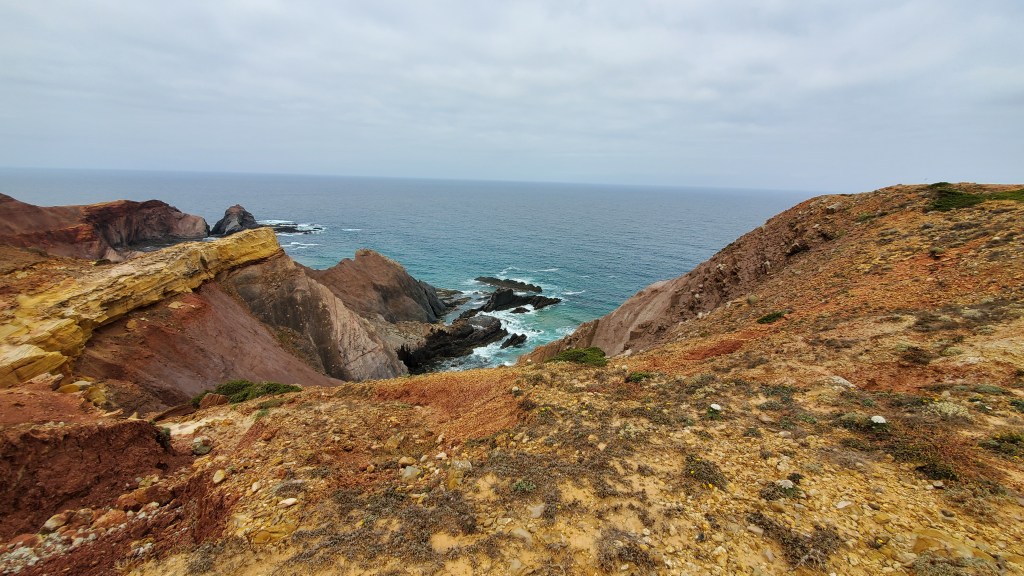
The entirety of the trail is exposed to the elements – winds are gusty and can be perilous for the vertiginous as sections of the path are on the very edge of precipitous cliffs; loose rocks and constant erosion are an ever-present danger. I found myself hugging the walls with my gaze fixed firmly upwards – below a sheer drop to an abyss of razor-edged boulders; if by some fortune, you survive the fall, the Atlantic is unlikely to be forgiving. The weather here on the very edge of the coast is temperamental and there is no shelter from the sun, thankfully, it’s mid-May and about 20c. Rains do come suddenly, the temperature plummets to freezing, and the path becomes a sodden muddy mess, caking footwear and making for a slow walk. And, just as suddenly, the rain stops but the wind cuts to the bone, numbing limbs. This is not a journey for the ill-prepared.
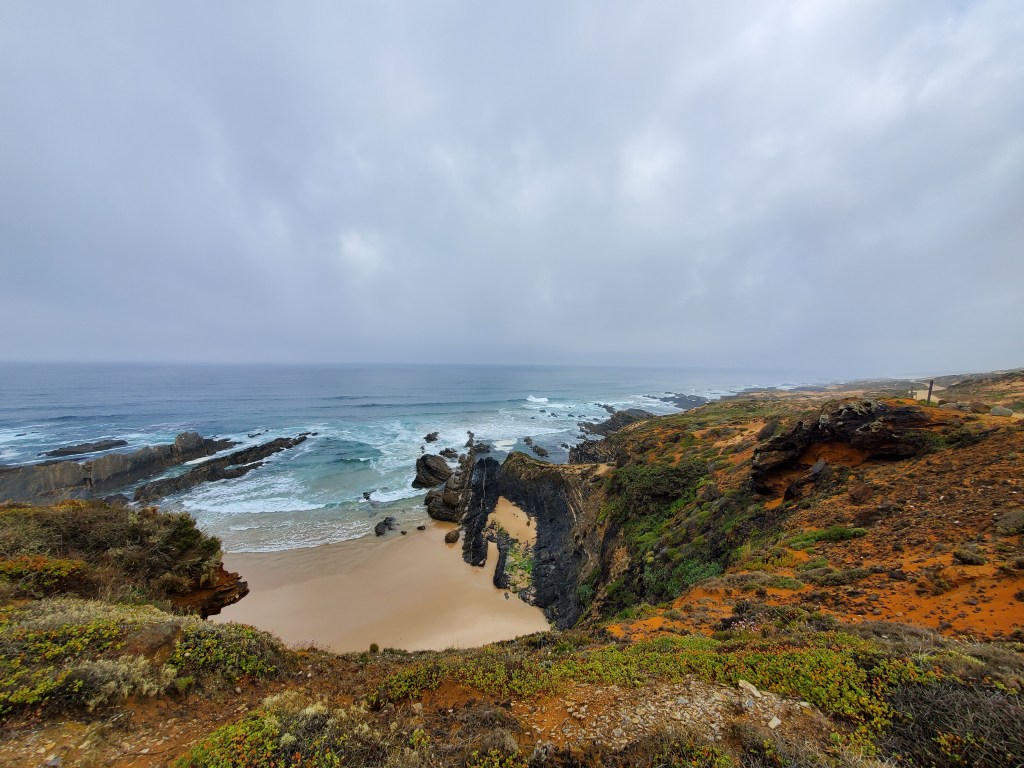
The villages and towns along the way – Almograve, Zambujeira do Mar, Odeceixe, Aljezur, Vila do Bispo, Sagres – are quiet, sleepy, and are far enough removed from urban centres leaving their equanimity undisturbed by mass tourism. There is little to do in these waypoint villages, but to slip into the mood and even keel of the place. The local inhabitants view passing hikers with mild curiosity, if they notice them at all – comfortable lodgings, cafes, and gastronomic gems, while not abundant, are easily found.


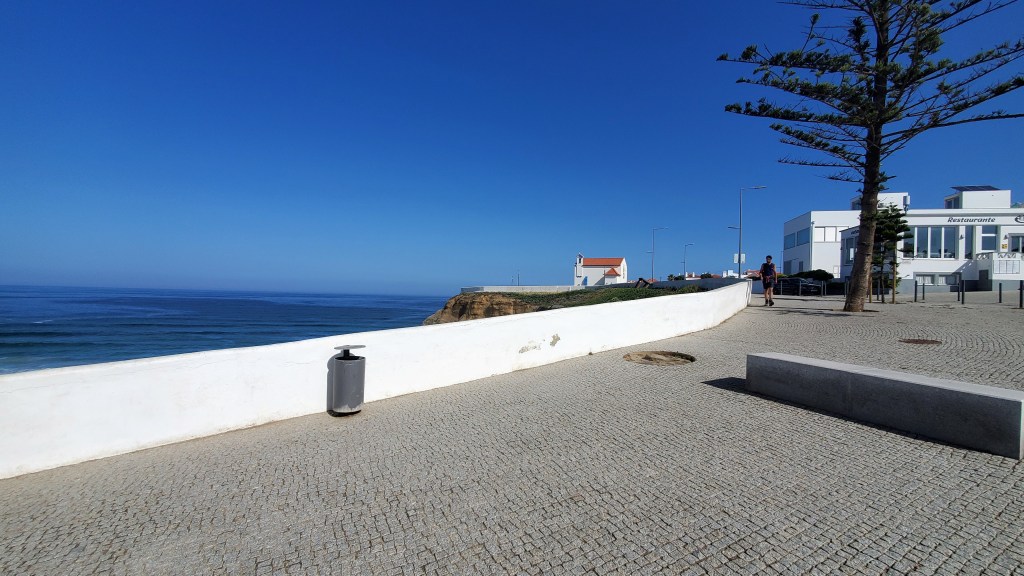
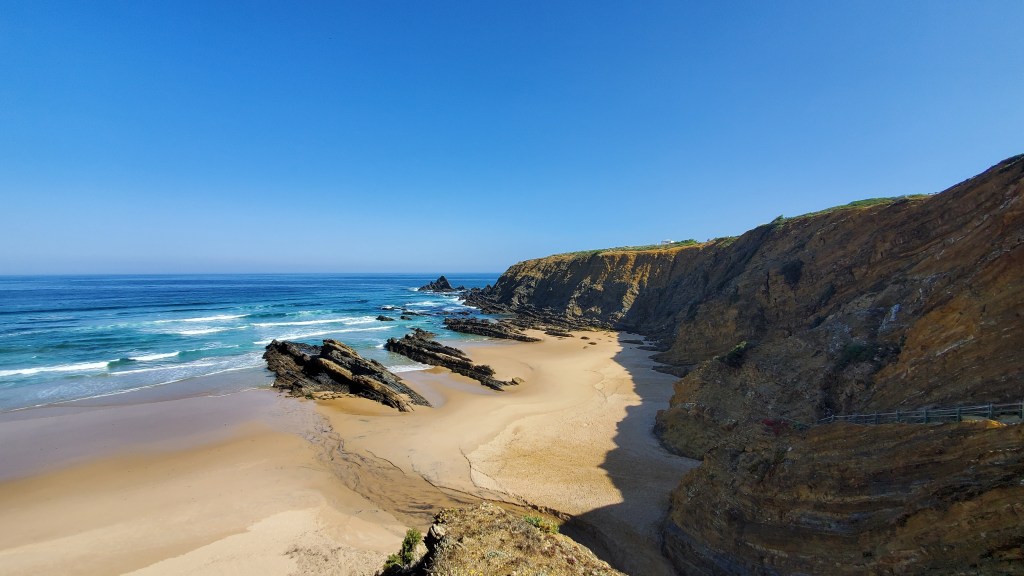
On the seventh and final day of my journey, my glutes stiff and sore, I arrive at my destination where the trail gives way to a paved road. It’s late afternoon, the sun is still high, and the Atlantic speckled gold and white shimmers. At the entrance, there’s a gate and fortified walls – and a man with thick wavy hair and a stylish linen jacket leafing through a magazine, a Frenchman by the looks of his coiffed moustache.
So, this is the end? I ask him.
Yes, this is the end, he replies in an Italian accent.
So, what’s there to it? I ask.
He gives me a look.
This is the end, he repeats.

I smile faintly and walk away lamenting my return to civilization and the decline in wit. I buy a cornetto from a nearby vendor and walk through the gates.
And, you know what, the end of the world isn’t such a bad place – there is a lighthouse, a decent café, a small museum, and several souvenir stalls along a paved two-lane road leading up to its entrance where tour buses disgorge throngs of tourists eager for selfies at the ‘I was at the End of the World’ mural. This is Cabo de São Vicente (Cape St. Vincent), named for a martyred and now little regarded priest from the 4th century, and it provides for a somewhat jarring end to my trek – after a week of isolation and few travellers to suddenly crowds of tour groups. I feel a quiet resentment. Who are these interlopers, these package-tourists, arriving in such comfort and free of sweat and dust just like the Italian in the linen jacket. I am dusty, my moisture-wicking shirt soaking in sweat, and firmly of the view that a selfie at the mural must be earned by a long pilgrimage, not some day trip. I find the cacophony of the masses a bit much for my sensibilities and seek a quieter spot, away from the little square and find a bit of solace at the far end of the base of the lighthouse – where I stand uninterrupted to gaze at the distant horizon at what the ancient world believed to be the end. Actually, the end of the world isn’t even the end of the world – that fame, being the most westerly point on continental Europe, belongs to Cabo da Roca, near Sintra, the fairy-tale city of painted castles a few hundred km north of here. But why quibble over romantic notions from centuries ago of where it was believed that the earth fell off the horizon into the deep unknown of the then unnamed and unexplored ocean, where the sun disappeared, and where sea monsters dwelled.


 www.solotravels.ca
Leave a comment